The Trust Effect on Professional Services Margins

Professional services NPS dropped 12% last year. From 63.5 to 56.0, across every firm size in the SPI benchmark, and below 60 is the recognized risk zone for client retention. The industry average just crossed into it. At the same time, new client acquisition rates are declining and revenue growth is running at roughly half of what the benchmark firms consider healthy.
Translate that out of survey language:
Clients are less loyal than they were a year ago, new ones are harder to win, and the growth engine is turning at half speed.
You have probably already felt it, even if you have not seen the erosion of NPS scores. Fees are getting negotiated harder. Clients who used to sign the proposal are now asking for a second option, a sharper pencil, a phased approach. Work you used to win on relationship is going to a competitive pitch, and you are in the room presenting credentials to people who already know you. And referrals, the quiet engine that built your practice, are arriving slower than they used to.
These look like sales problems - they are actually trust problems.
Trust problems have a number.
Trust shows up in a professional services P&L in three places. I bet you think about these all the time, but it's good to look at your P&L in terms of trust skills in your teams.
First, cost of sale. A referred client arrives half-sold. They close faster, negotiate less, and skip the beauty contest. A cold prospect makes you earn every dollar of credibility from zero, at full pitch cost.
Second, price. Fee pressure is what a client applies when they cannot tell you apart from the alternative. A trusted advisor gets the benefit of the doubt on price because the client is not buying hours; they are buying confidence. Commodity providers get procurement. Trusted ones get a phone call.
Third, retention (the big one). Bain's foundational loyalty research found that a 5% improvement in client retention lifts profitability by 25 to 95%, and that acquiring a new client costs 5 to 25 times more than keeping one. Those numbers are decades old and still hold, because the mechanics have not changed: a retained client requires no pitch, no discount to win, and no ramp-up cost to serve.
Run the napkin math on your own firm. Say you have 40 clients averaging $80,000 in revenue a year, and you lose six of them annually. That is $480,000 in revenue to replace before you grow a single dollar. You will replace it at 5 to 25 times the cost of keeping it, and you will sell it at pitch-stage fees instead of trusted-advisor fees. Every point of retention you win back drops almost entirely to margin, because the cost of serving a client you already have is already sunk.
This is old news. But the pain of lower client retention is increasing. And the effect just gets bigger if you bill more per client!!!!
Where loyalty lives has moved. Lots of firms have not yet noticed
For twenty years, firms have measured loyalty with one question: how likely are you to recommend this company? It worked because the answer predicts revenue. Bain's research shows Net Promoter Score leaders grow at roughly twice the rate of their competitors. Promoters cost less to win, pay more willingly, stay longer, and do your marketing for you. That is the loyalty math, and it is settled.
What moved is where loyalty lives. Much of it has moved from the firm to the professional. No matter how much you spend on brand advertising, clients put their bet on their relationships with your senior people.
In professional services and considered B2B, where the relationship is the product, buyers have stopped recommending firms and started recommending people. Ask yourself how the last referral into your firm actually happened. Few new clients say "you should hire that agency." They say "you should talk to Sarah." The client's loyalty is increasingly attached to a person, and your firm collected the revenue because that person works for you. The brand got the credit. The relationship did the work.
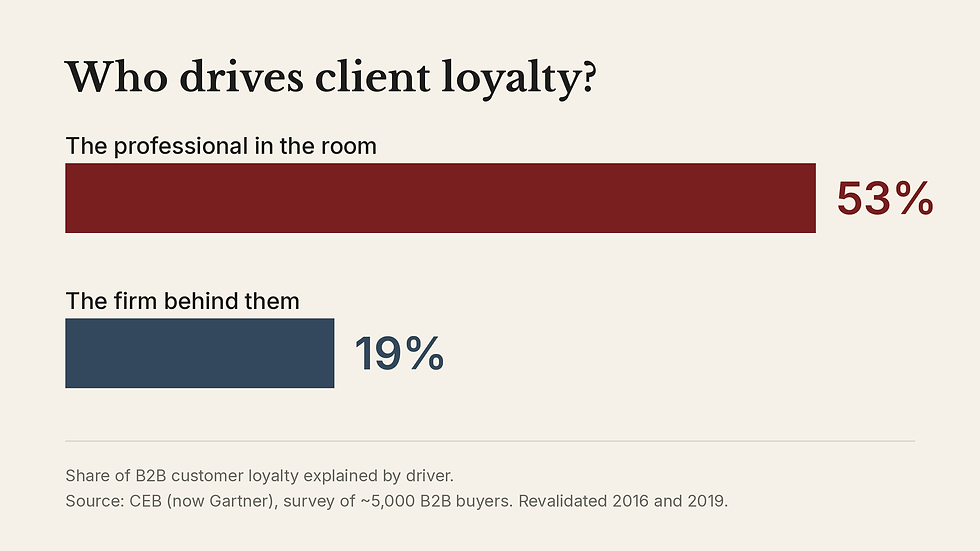
The data has been saying this for fifteen years. The largest study of B2B buyer loyalty ever run, roughly 5,000 buyers surveyed by CEB (now Gartner), found that the sales experience, what the professional actually does with the client, drives 53% of loyalty. More than brand, product, service quality, and price combined. Company and brand impact accounts for about 19%. The study was revalidated in 2016 and again in 2019, and the individual experience stayed on top.
Read those two numbers side by side.
The professional in the room drives more than half of client loyalty. The firm behind them drives about a fifth. The loyalty measurement industry built its dashboards around the fifth.
So here is the situation. Your firm has an NPS. So do you. Nobody is measuring yours.
What's your personal NPS?
Try the uncomfortable version of the ultimate question. Would your last five clients recommend you, by name, unprompted?
Not your firm. Not your team. You.
Most ambitious professionals have never asked it, because the answer is checkable and the check is scary. But the drivers of a high personal score are known, and they have been stable since the earliest work on what makes an advisor trusted. Four of them matter: credibility, reliability, client knowledge, and self-orientation. The first three build trust. The last one divides it.
Credibility and reliability are table stakes. Every serious competitor has them. The driver you can actually win on is client knowledge, how deeply you understand their business, their pressures, their world. And self-orientation is the killer. A client becomes a promoter when the felt experience of working with you is "this person is about me." One conversation where you are visibly about you, and the score drops.
Put the whole logic in one chain:
Credibility + Reliability = the ticket in. Table stakes. Everyone at your level has them.
Client Knowledge > Self-Orientation = trust. The only contest still being scored. Every client conversation asks one question: was I more about them than about me?
Trust = promoters. Clients who recommend you by name, unprompted.
Promoters = retention, referrals, revenue. The three R's. And how to drive your firms margin and growth!
The three R's = margin. Which is why trust skills belong on the firm's P&L.
The same number runs your career.
Past a certain level, nobody advances on technical excellence. The work is assumed. What separates the professionals who make partner, get the P&L, or land the bigger seat at the boardroom table is that clients ask for them by name, refer them without being asked, and follow them when they move.
That is a personal NPS expressed in career terms, and it is the leading indicator your firm's leadership is reading whether they call it that or not.
Same skills, two payoffs. The firm gets margin. You get promoted.
Trust is a skill. Skills have drills.
Your personal NPS is not a personality trait. It is a trailing indicator of practiced behavior: what you ask, how you listen, whether you frame the problem before you solve it, and how you show up in the moments that matter most to the client. Which means it moves. Professionals who practice the behaviors watch the number follow, the same way firms that fixed their client experience watched their firm-level score recover.
Start with a five-client audit
Start with a measurement you can do today. Name your last five clients. For each one, answer honestly: detractor, passive, or promoter? Would they recommend you, by name, unprompted?
If the honest answer makes you wince, good. That wince is the trust effect showing up on your personal balance sheet before it shows up on the firm's. The chain runs in both directions: margin traces back to the three R's (retention, referrals, revenue), the three R's trace back to promoters, and promoters trace back to whether your client knowledge outweighed your self-orientation in the conversations that mattered.
And if you can't honestly answer that is an even bigger challenge. For you. For your firm.
If you want to find out what is driving your number, that is exactly what a trust audit is for. It is one conversation, one transcript, and one finding you can act on next week.


Comments